Scientific Computing · Current project
Aevrilo
A local research workspace for traceable tensile analysis: from machine exports to versioned results, specimen comparison, and reproducible reports.
Overview
What is Aevrilo?
Aevrilo is a research workspace that helps people understand how materials behave when stretched. It takes measurements from a tensile-testing machine and brings the curves, specimen information, analysis, and research notes into one place.
A researcher can inspect a test, record the specimen’s dimensions, compare samples, and produce a report while keeping the connection to the original measurements.
Why I built it
A material-property number means little without knowing how it was obtained. Which sample did it come from? Were the dimensions measured or assumed? Which part of the curve was used? Did someone review that particular analysis?
Aevrilo grew out of my earlier tensile-analysis dashboard. The new application puts those questions at the centre of the experience: results travel with the information needed to understand them.
What using it looks like
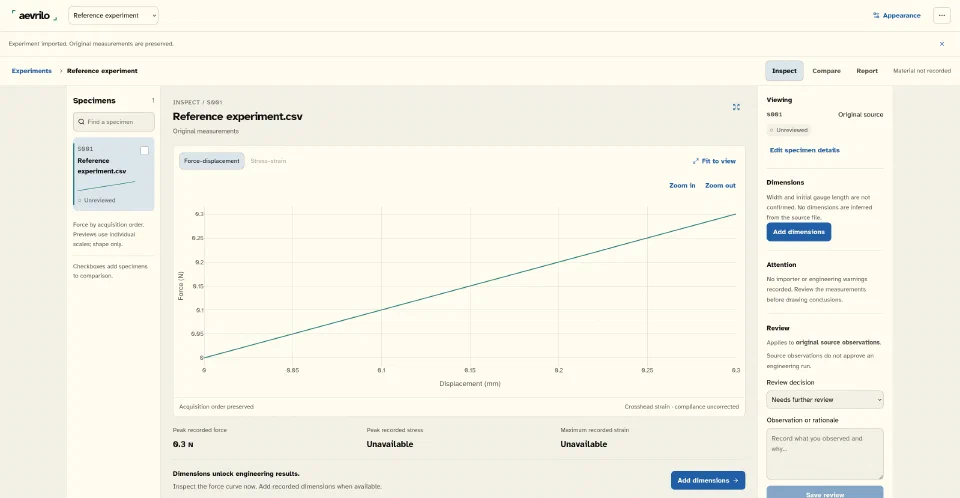
The workspace follows three stages: Inspect, Compare, and Report. The specimen list stays beside the curve and its supporting information, so researchers can move between samples without losing context.
During inspection, they can enter dimensions, examine a curve, and record their interpretation. Comparison brings selected samples together. Reporting turns those choices into PDF and CSV outputs with the relevant context attached.
The screenshot shows the real interface using a synthetic reference experiment. Dimensions have not been entered yet, so the application shows the measured force curve and leaves stress and strain unavailable.
Technical detail
Separating the science from the interface
Aevrilo combines a React and TypeScript frontend, a FastAPI backend, and a SQLite workspace. The numerical methods live in a separate Python core, keeping the calculations independent of the interface that presents them.
- Machine export + explicit units
- Specimen geometry
- Engineering curve + selected fit
- Saved analysis + review
- Comparison + research report
From machine readings to meaningful curves
CSV and XLSX imports use explicit column and unit mappings. Engineering stress is calculated from force and cross-sectional area; strain comes from the declared measurement source and specimen geometry. Measured strain, extensometer extension, and crosshead displacement remain distinguishable because they carry different physical meaning.
Geometry records distinguish measured values from confirmed assumptions. Changes such as cropping or baseline correction retain their settings and a researcher-provided reason, while original measurements remain available.
Making interpretation visible
For elastic-modulus estimation, a researcher selects a curve interval. An ordinary-least-squares fit produces a slope, intercept, R², residuals, and slope standard error. The result remains a candidate requiring scientific review: a straight line alone does not establish that the selected region represents elastic behaviour.
Each saved analysis captures its geometry, processing settings, method version, and experiment context. Changing an input creates a successor analysis rather than overwriting the earlier one. Reviews apply to the specific analysis being viewed, so an earlier inclusion decision cannot silently approve a later calculation.
Comparing and sharing results
Group summaries use available metrics from reviewed, included runs. Incompatible processing and potential duplicate source files prevent misleading pooling. Sample standard deviation is reported separately from the individual specimen results.
Portable experiment bundles carry original data, saved analyses, and review history. Restoration checks their integrity and recomputes supported results before saving the experiment. Report exports use a consistent snapshot so a changed selection or review cannot silently produce a different report from the one previewed.
Where the project is heading
The current application supports engineering curves, explicit-window modulus candidates, specimen comparisons, portable experiments, and PDF/CSV reports. Yield and fracture extraction are planned rather than implemented. Laboratory pilot work and domain review are the next steps toward practical research use.
Aevrilo’s source code is currently private. A public source link will be added when it becomes available.