Machine learning
Reinforcement learning experiments
Q-learning and deep reinforcement learning in FrozenLake, CartPole, and a custom Tank Dodge environment.
Overview
Teaching an agent through consequences
Reinforcement learning is about learning what to do by observing the consequences of an action. This project explores that idea through simple control tasks and Tank Dodge, a custom game in which an agent must keep moving to avoid approaching enemies.
The agent receives a reward for surviving and a penalty for collision. Over training, it learns a movement policy from those signals rather than from a list of correct moves.
The collection progresses from tabular Q-learning to deep-learning approaches, connecting algorithm design with an environment that makes the agent’s behaviour visible.
Watch the agent
| Policy | Mean episode return | Mean episode length |
|---|---|---|
| Saved PPO checkpoint (greedy) | 377.5 | 388.5 steps |
| Uniform random actions | 224.5 | 235.5 steps |
Both policies use seeds 0–9 with matched initial environment states. The random policy uses an independent action RNG. Return includes the −10 collision penalty. Explore the per-episode results.
Technical detail
Designing the learning problem
Tank Dodge exposes the player’s position, enemy positions, and relative positions as normalised coordinates. With three enemies, the observation contains 14 values. The policy chooses one of four movement directions.
- Observe positions
- Choose a movement
- Advance the environment
- Receive survival or collision reward
- Update the policy
Using coordinates instead of pixels keeps the experiment focused on control and policy learning. The reward is +1 for a surviving step and −10 for a collision.
Comparing learning approaches
DQN learns action values using a replay buffer and an exploration policy. Double DQN separates action selection from value estimation. PPO uses an actor–critic model, generalised advantage estimation, and clipped policy updates.
Training and playback are separate workflows, allowing a saved policy to act without continuing to update its weights. The environment also supports headless execution for rollouts without rendering.
Learning over time
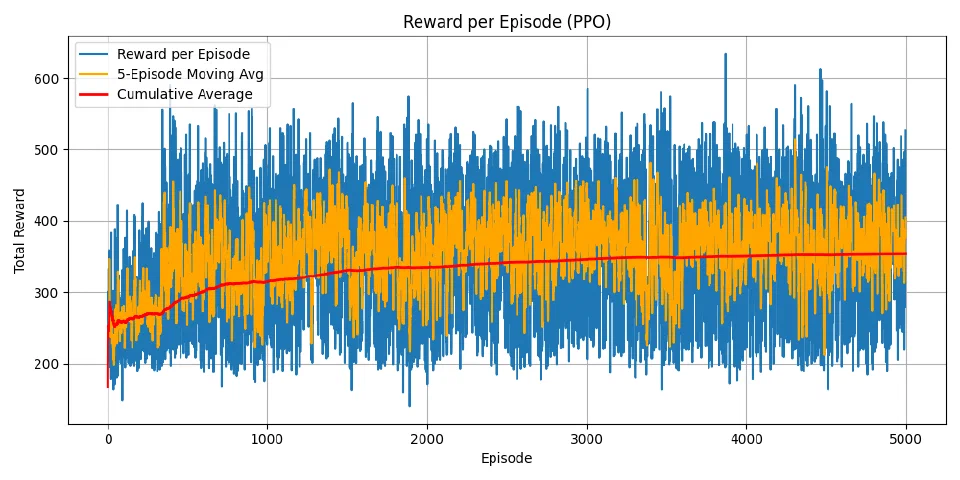

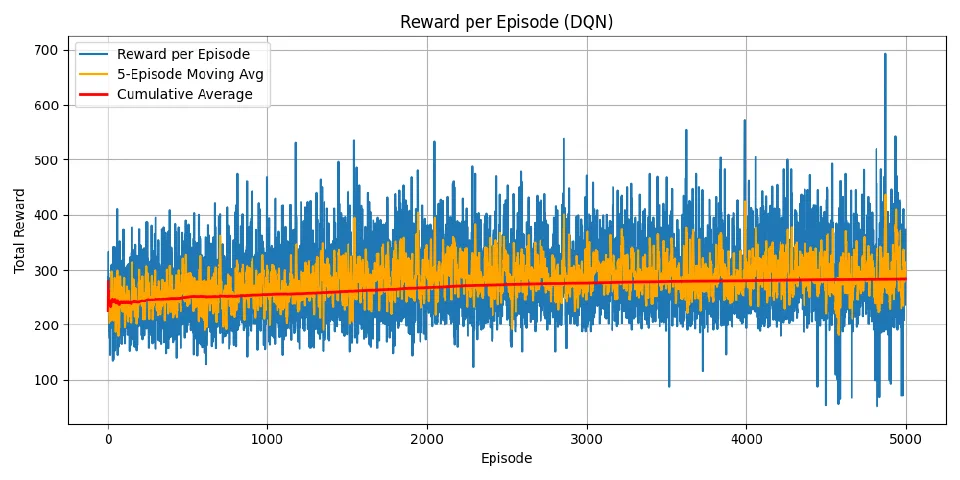

The playback comparison above covers one saved PPO policy on ten starting seeds, with random actions as a baseline. Broader comparisons would need multiple independently trained policies and the same environment and training budget for each algorithm.